Get email alerts for new off-market deals — curated drops, no spam.Get deal alerts via email
OffMarket Deck · Updated 2026-06-20
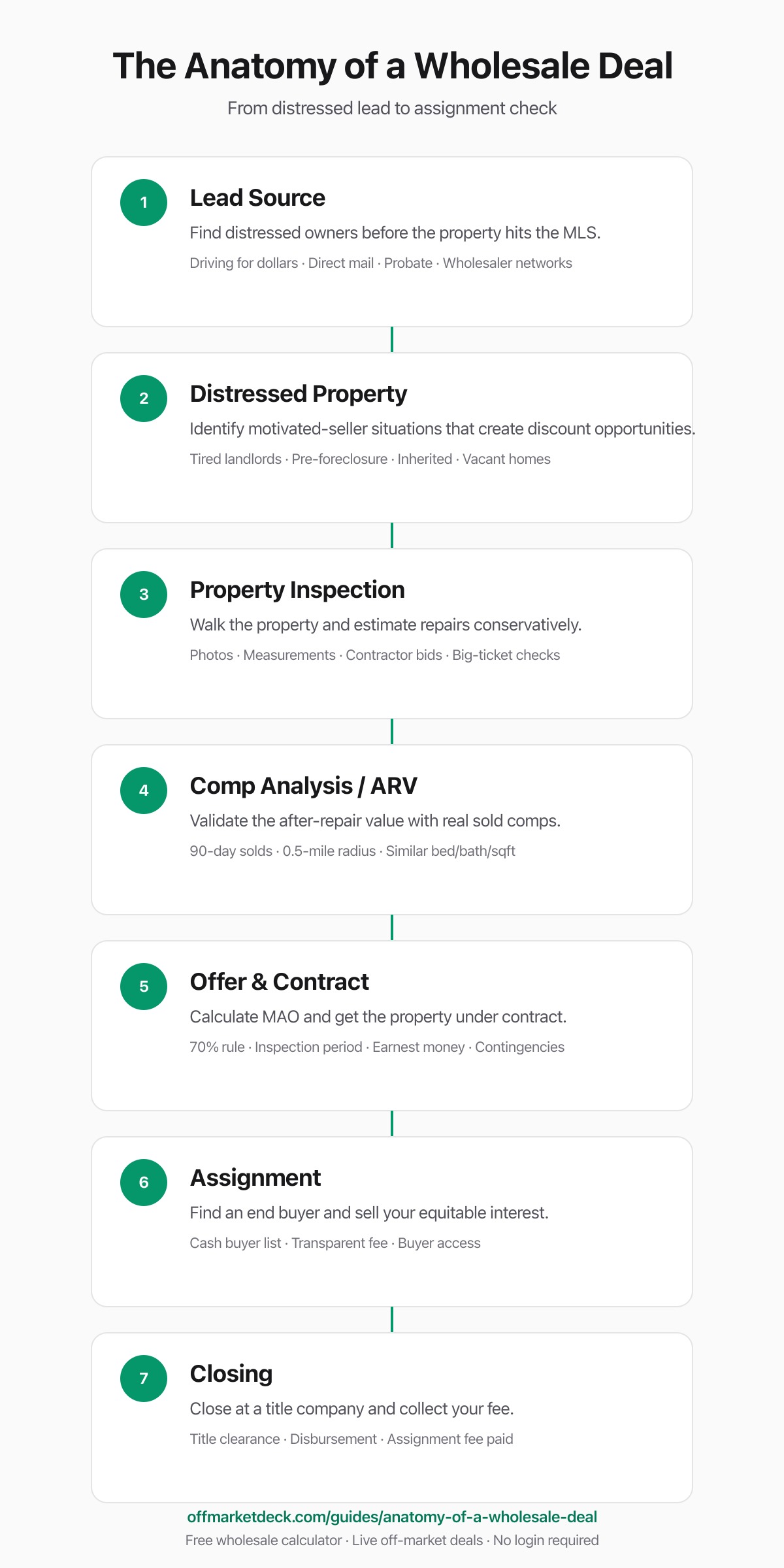
A wholesale deal is not about buying real estate. It is about securing the right to buy real estate, then selling that right to an end buyer for a fee. It is one of the lowest-capital ways to participate in real estate investing, but it is also one of the most misunderstood. Done correctly, wholesaling connects motivated sellers with cash buyers who can close quickly. Done poorly, it produces broken contracts, angry sellers, and legal exposure.
Every wholesale deal starts with a seller who values speed, certainty, or convenience over top dollar. Common motivations include foreclosure, probate, divorce, job relocation, tired landlords, inherited properties, and homes needing more work than the owner can handle or afford. The wholesaler's job is to identify these sellers, build rapport, and make an offer that solves their problem while leaving enough margin for an end buyer to profit.
Marketing to motivated sellers typically involves direct mail, cold calling, driving for dollars, online advertising, probate research, code-violation lists, and relationships with attorneys and other investors. The best wholesalers track lead sources and cost-per-deal obsessively so they can scale what works and cut what does not.
The wholesaler negotiates a purchase contract with the seller at a price low enough that an end buyer can still profit after repairs, closing costs, and the wholesaler's assignment fee. The contract must be assignable unless the wholesaler plans to double-close. It should include a reasonable inspection period, clear closing timeline, and enough earnest money to show seriousness without overcommitting capital.
The purchase price is not random. It is derived from the after-repair value (ARV), estimated repair costs, desired end-buyer profit, closing costs, and the assignment fee. Use the free flip calculator to sanity-check whether the deal leaves enough room for everyone. If the numbers only work with optimistic ARV or underestimated repairs, the deal will fail at marketing.
Wholesalers build and maintain a list of cash buyers, typically fix-and-flip operators, buy-and-hold landlords, BRRRR investors, and sometimes landlords looking for turnkey rentals. The best wholesalers know each buyer's preferred markets, price range, property type, and renovation appetite before marketing a deal.
Building a buyer list takes time. Methods include attending local REIA meetings, networking at contractor supply houses, running Facebook investor groups, posting deals with assignment fees on disposition platforms, and simply asking every cash buyer what they want. A strong buyer list is the single most valuable asset in a wholesaling business because it lets the wholesaler move deals quickly and command higher assignment fees.
The wholesaler assigns the purchase contract to the end buyer for an assignment fee. The fee is the difference between the contract price and what the end buyer agrees to pay. Assignment fees can range from a few thousand dollars on small deals to $50,000 or more on larger commercial or high-equity residential deals.
The assignment is documented with an assignment agreement that clearly states the fee, the assignee's obligations, and the timeline. Transparency matters. Experienced wholesalers disclose the original purchase price and assignment fee clearly to avoid disputes at closing. In some states and title-company relationships, a double close is preferred over an assignment, particularly when the assignment fee is large.
The end buyer closes with the seller according to the original purchase contract. The wholesaler collects the assignment fee at closing, usually from the buyer's funds. In a double close, the wholesaler briefly takes title to the property before immediately reselling it to the end buyer. Double closes require more capital and two sets of closing costs but can be necessary when title companies or state laws discourage assignments.
Wholesaling math is simple in concept and unforgiving in practice. The formula is: Maximum Allowable Offer = ARV minus repairs minus buyer profit minus closing costs minus assignment fee. If any input is wrong, the deal collapses. Use the free flip calculator to verify ARV, rehab, and profit margins before you sign a contract. If the numbers do not work for your end buyer, the assignment fee is not sustainable.
Wholesaling is legal in most states, but how you structure the business matters. The key distinction is whether you are marketing the property or marketing the contract. Marketing a property you do not own can be interpreted as brokering real estate without a license, which is illegal in most jurisdictions. Marketing your equitable interest in a purchase contract is generally treated as selling a personal property right, which does not require a real estate license.
Best practices include using a clear, assignable purchase contract, disclosing your intent to assign in writing to the seller, and working with a title company or real estate attorney familiar with assignment transactions. Some states require specific disclosures or have restrictions on assignment fees. If you are wholesaling in multiple states, review each state's real estate commission guidance and consider working with a local attorney to ensure compliance.
Ethical wholesaling also means not locking up properties you cannot close or assign. A contract is a commitment to the seller. If your only exit strategy is finding a buyer, you should have a realistic plan and timeline for doing so. Building a reputation for reliability is more valuable than maximizing any single assignment fee.
Treat wholesaling as a marketing and relationship business, not a transaction business. Consistent lead generation, honest underwriting, transparent assignment fees, and reliable buyer relationships compound over time. The wholesalers who last are the ones who leave money on the table occasionally to protect their reputation, rather than the ones who squeeze every deal until it breaks.
Use this visual on your site. Please link back to OffMarket Deck.
<p>
  <a href="https://offmarketdeck.com/guides/anatomy-of-a-wholesale-deal" target="_blank" rel="noopener noreferrer">
    <img src="https://offmarketdeck.com/images/anatomy-of-a-wholesale-deal.jpg" alt="The Anatomy of a Wholesale Deal - Free Visual Guide" style="max-width:100%;height:auto;" />
  </a>
</p>
<p>Infographic courtesy of <a href="https://offmarketdeck.com">OffMarket Deck</a></p><iframe src="https://offmarketdeck.com/tools/infographic/anatomy-of-a-wholesale-deal" width="100%" height="1400" style="border:none;" title="Anatomy of a Wholesale Deal"></iframe>Active off-market real estate deals across the US.